




EEG-triggered Awareness for a Collaborative Robot
Conference Publication - In Press
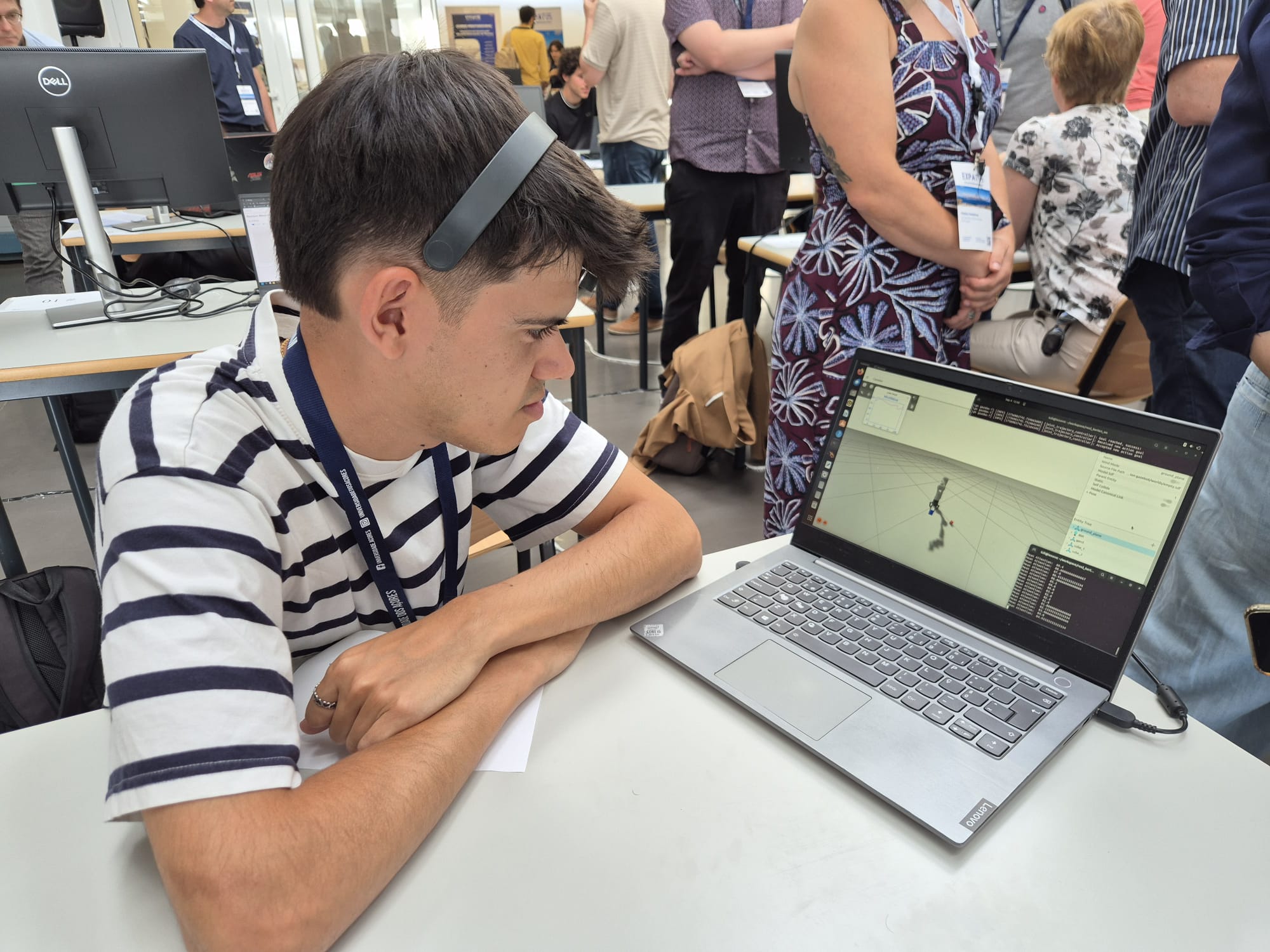
In this work, recently presented and published as part of the proceedings of IEEE’s 7th Experiment@ International Conference (exp.at’ 2025), in island of Faial, Portugal, we present a cobot capable of switching its operations between task completion and user tracking, based on data broadcast by a single-channel EEG headset (NeuroSky MindWave) worn by the user. The purpose of this adaptive application is to evaluate the impact on the user of having a cognition-sensitive robotic colleague, pondering ramifications towards danger incidence and productivity improvement.
Given how awareness, or the ability of human workers to remain conscious of their surrounding operatives, is a strong contender to an ideal safety-productivity conciliation, the key aspect of this approach rests on being able to determine whether a user is aware of their actions and surroundings or not.
In terms of electroencephalographic signalling, the partition of acquisitions into different frequencies determines the type of wave under scrutiny. Specifically, alpha wave activity has been extensively shown to decrease as attention enhances, in both human and animal studies. Thus, continuous monitoring can enable the modulation of robot activity in response to sustained human attention, or its lack thereof.
While performing a collaborative task, and considering that the robot can determine worker attention via EEG signal interpretation, it should also demonstrate this knowledge in a manner perceptible to the user. Thus, imposing task completion contingent on sustained attention, the robot can also switch to a tracking demeanor while the human-directed part of a task is completed.
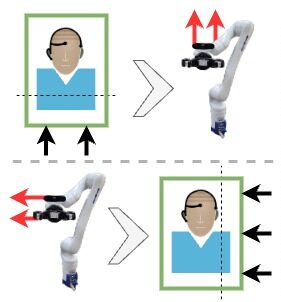
By detecting the user body and translating its corresponding pose’s 2D coordinates into mirrored 3D joint twist velocities, the robot can demonstrate an enchanted snake-like behavior, focusing on worker actions. Naturally, this resorts to a body pose detector and corresponding coordinate homography, then normalized and used to scale joint velocities, which maintain robot movement.
Ideally, human workers experiencing this adaptiveness can experience a reduction in uneasiness when working in proximity with industrial machinery and collaborative robots. There is value in this approach, as it reduces the sense of immediate danger, improves overall well-being, and possibly also reduces the rate of accidents.
Naturally, positive effects are only expected to happen with habituation, as users become more aware of the collaborative robot’s interpersonal skills. Eventually, it becomes natural for human users to expect these robotic counterparts to ensure safety, much like human peers, thus fostering a healthier work environment.
To exemplify the dynamic, here we see a young researcher experiencing a simplified EEG-based modulation of a simulated Kinova, at exp.at’s demo session.