




Exploring the Role of Robot Interaction Style in Human-Robot Collaboration
Conference Publication - In Press
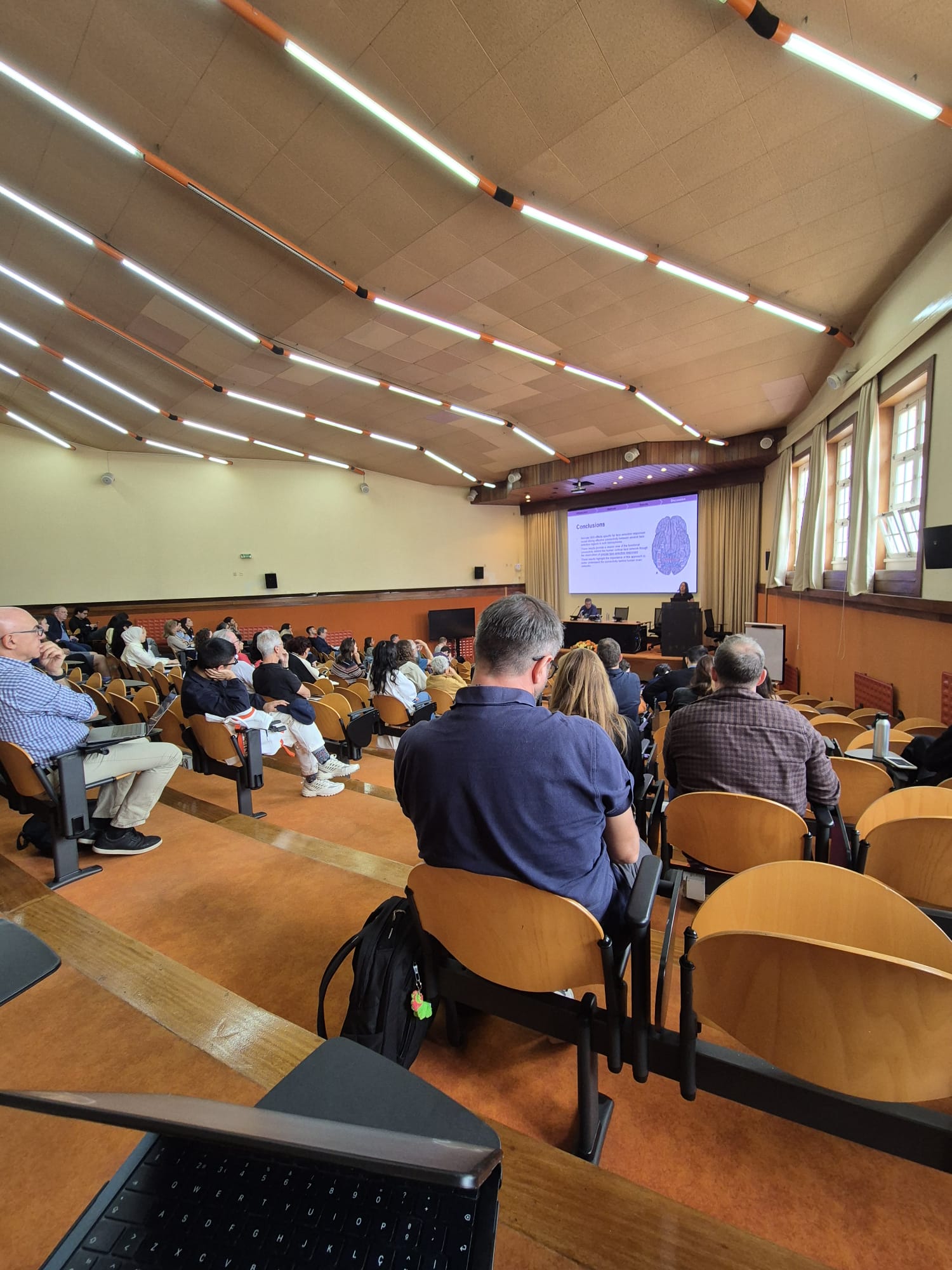
This preliminary work was presented at the 3rd Seeing and Acting Workshop (SAW 2025), an initiative sponsored by the EU’s Era Chair Action CogBooster and organized by the Faculty of Psychology and Educational Sciences of the University of Coimbra. Here, we presented the main study designed for the CoDRI project, envisioning continuous demeanor adaptation for collaborative robots, based on biofeedback from human workers. This work combines methodologies from two major fields, namely neurobiology and psychology, each with its own intricacies and dedicated approach. Given the complementarity of these fields, the goal is to construct meaningful feedback signalling during tasks where human and robot work together. Via reinforcement, AI methodology can then be used to control the robotic counterpart more autonomously.
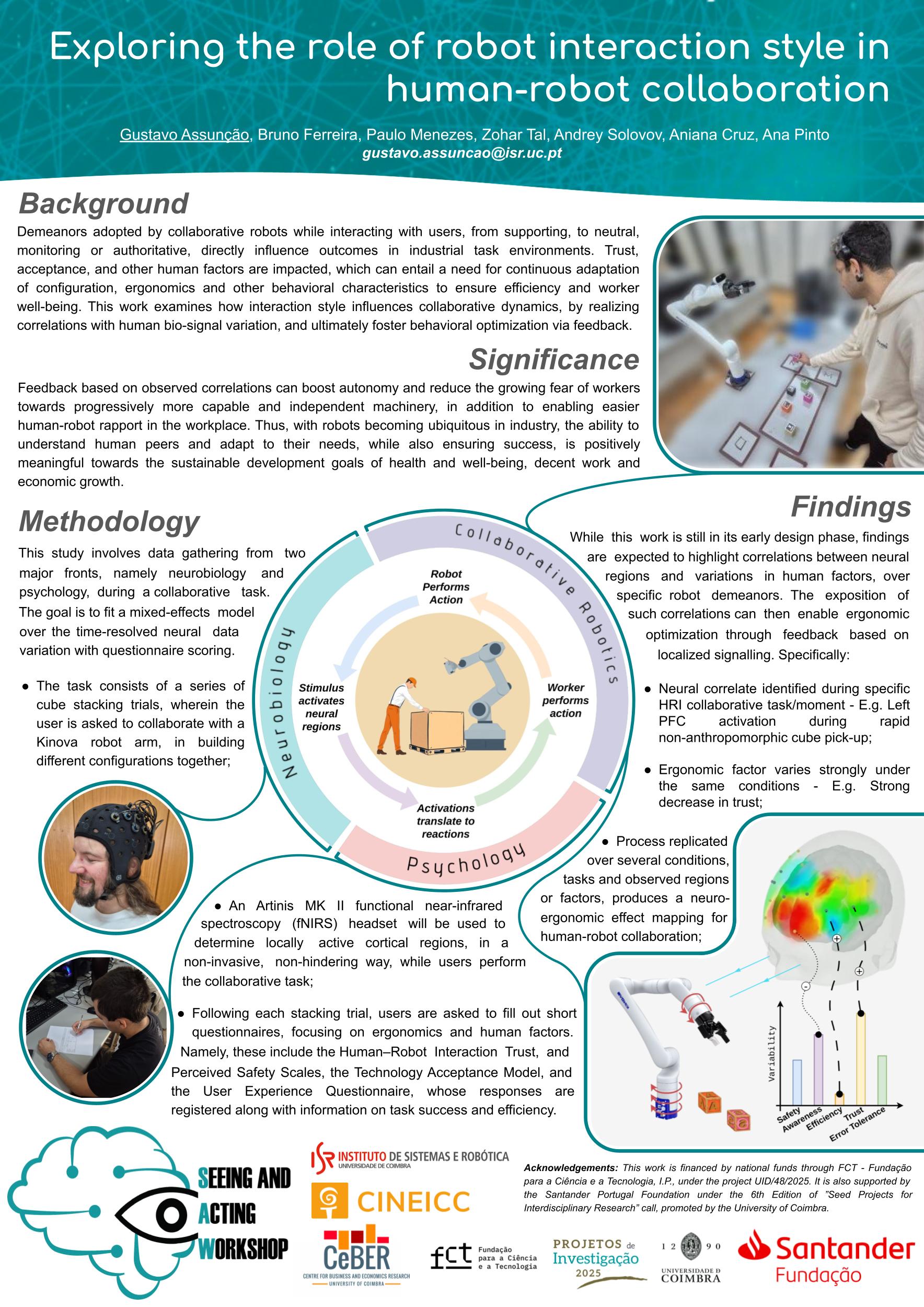
In terms of collaborative tasking, and considering the experimental nature of this work, simple cube stacking trials are planned to be shared between human worker and a Kinova robot arm. Objectives center around the construction of different configurations with the available material.
In order to obtain neurophysiological data in a non-intrusive and minimally cumbersome way that can provide insight regarding the spatial activation of specific brain regions, the approach relies on fNIRS technology. Thus, an Artinis MK II headset with 10 transmitters and 8 receivers is provided for participants to wear during collaboration with the robot arm. Moreover, a 27-channel arrangement is employed to acquire signal over the prefrontal cortex (PFC), considering its variety of sub-areas associated with not only planning and executive decision, but also primal survival responses arising from the primitive limbic system.
As for the psychological aspect of data collection, and in order to remain unobtrusive to ongoing collaboration, post-task surveying provides the necessary input to probe ergonomic impact. This surveying includes the filling out of the Frankenstein Syndrome Questionnaire, and the Human-Robot Interaction Trust and Perceived Safety scales, to gauge these factors and correlate their variation with observed activations of PFC sections.

With both neurophysiological signalling demonstrating PFC activation, and user self-reported variation of human factors during collaborative tasks, it becomes possible to fit a mixed-effects model over the time-resolved neural data and the static ergonomic scoring. With this model, the natural next step is to bridge any observed correlations into feedback signal construction, which can adequately provide collaborative robots with information to adapt themselves and their behavior. To provide an objective example, during rapid non-anthropomorphic cube pick-up, left PFC activation may co-occur with a strong decrease in trust. Consequently, robot demeanor may incur a speed adaptation triggered by left PFC activation, with the goal of increasing or maintaining trust, at least.
Replicating this experimental process, with variable conditions, tasks and observed cortical regions/ergonomic factors, is considered as a major goal of the CoDRI project. This is because it can lead to the production of a neuroergonomic effect mapping for human-robot collaboration, which by itself can mean considerable prospective applications involving feedback.
Having presented the work at SAW, we then had the opportunity to attend the remaining sessions of the conference, with novel insight into topics tied to perception, cognitive mapping, navigational strategies, and several others.