





About Us
The project, fully titled Cognitive-Driven Robot Interaction (CoDRI): Exploring the Role of Neural and Psychological Feedback in Collaborative Robotics, started with a desire to develop an original line of research connecting the different disciplines explored by Gustavo Assunção during his PhD, namely within the areas of Neurophysiology, Psychology and AI, and from that develop novel methodology for autonomous robot adaptation in industry. Combining efforts from 3 separate research centers and 6 researchers, the project gained its first funding round in early 2025, from the Santander Foundation, via the SeedsProjects@UC initiative (Digital, Industry and Space branch), and has been ongoing since.
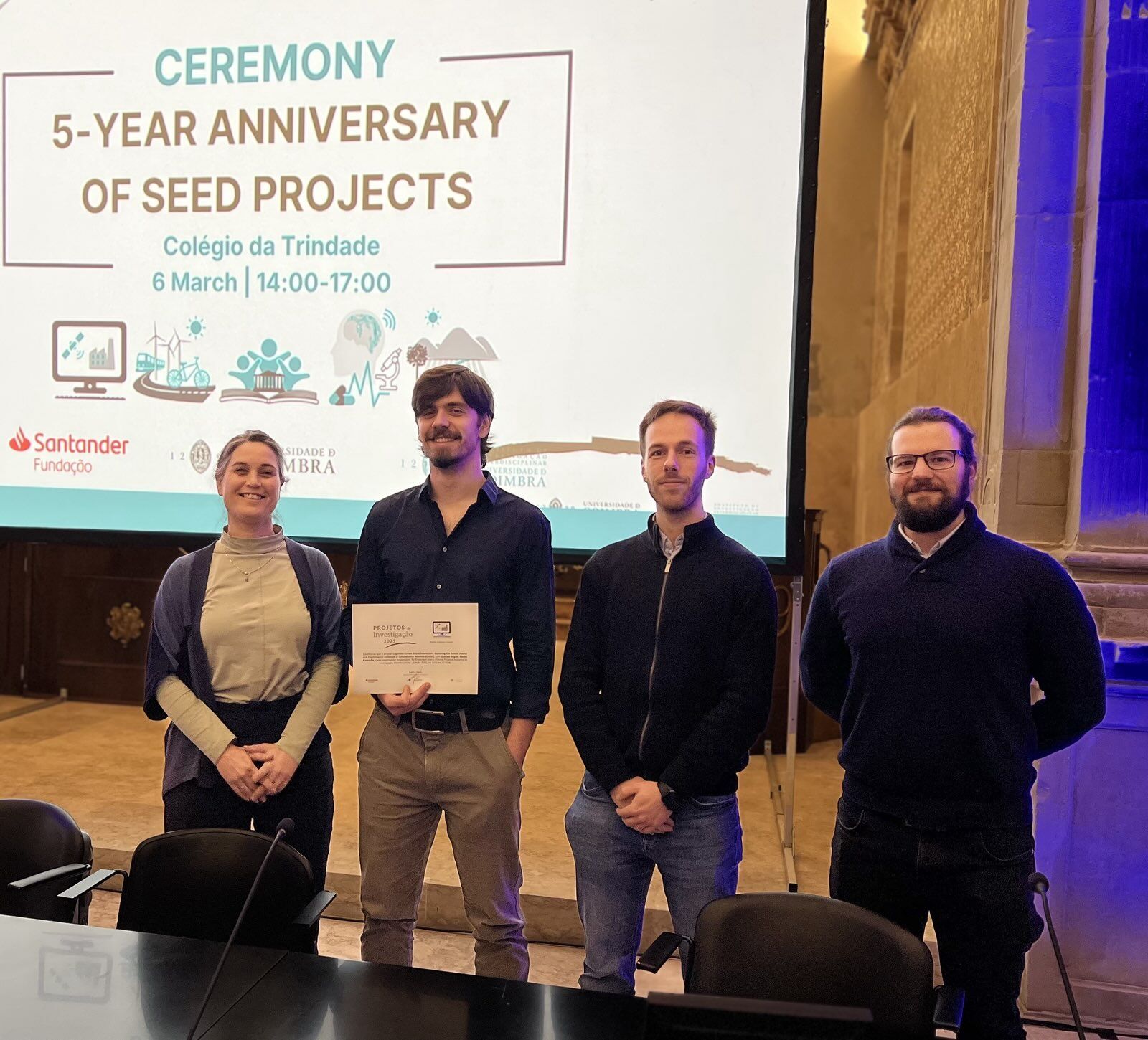
From left to right we have Zohar Tal, Gustavo Assunção, Bruno Ferreira and Andrey Solovov, attending the award ceremony to accept the grant from the Santander Foundation.
To give a short summary of the original proposal, we must dive into the relationship between stimulus and impact over users. Specifically, robot physical and social characteristics have a distinct influence over user perception, being objectively measurable within a range of neuronal and psychological modalities. Considering there is a growing adoption of robotics in our time, there is also a need to understand this influence and the polarized impact certain traits incur. By doing so, we are able to work towards greater machine acceptance, better working conditions, and consequential enhanced efficiency. Thus, CoDRI aims to associate robot activity and its attributes with observational and self-measurable psychological factors, as well as neural correlates detectable by non-invasive brain-computer interfaces (BCI). This way, we can explore how certain activations may serve as direct feedback for deep learning controlling machinery, in addition to correlating them with system ergonomics, to achieve more natural interactions. Ideally, this realizes improvements for both the industrial and social aspects of collaborative robotics.
Having clarified that, a full proposal was drafted and presented, to which the original grant was awarded and allowed us to formulate the team and start working on the topic. Naturally, this started with a first public dissemination opportunity, where Gustavo, the principal investigator, pitched CoDRI.
The project initially envisioned the establishment of neural regions and the assessment of human factors, hypothetically associated with robot behavior. This path aimed for a subsequent empirical confirmation in real scenarios. Recruiting participants for data gathering follows as the next step, to solidify extracted relationships between different correlates and human factors. With this information, then an application in computational learning is planned, meant for testing with collaborative robots in th real world. Outcomes are expected to guide robot design as well as lead to greater behavioral adaptability, as explained.
If this topic interests you and you would like to get involved, or find out more about the project, feel free to browse through the website or reach out via our Contact page!